

From the Mayor: Can We Describe What We Are Celebrating on this Fourth?
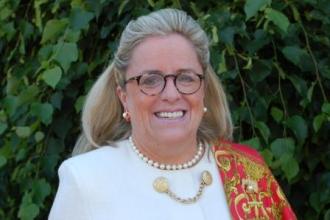
By Mary C. Marvin, Mayor of Bronxville
Jul. 6, 2016: I write this as I await the televising of the Macy's fireworks celebration after a weekend of friends and family.
What words can describe what we are celebrating this Fourth?--freedom, independence, sovereignty, heroism, bravery, and probably most important--gratitude. FDR's words of over 70 years ago resonate so clearly today. "Those who have long enjoyed such privileges as we enjoy forget in time that men have died to win them."
The men who signed the Declaration of Independence gave of themselves beyond measure.
When 56 men of the Second Continental Congress penned their signatures in Philadelphia, they were fully aware that it was an act of treason punishable by death. The famous John Hancock, wealthy merchant, president of the Second Continental Congress, and first governor of Massachusetts, was the first to sign, and he signed boldly, reputedly so "the British Ministry can read that name without spectacles." As he put the pen down, he is said to have exclaimed, "May they double their reward."
To a man, they were well educated, soft spoken, and had security, but, as they said, "they valued liberty more."
Their signing statement, written in unanimous accord, reads, "For the support of this Declaration, with firm reliance on the protection of the divine Providence, we mutually pledge to each other our Lives, our Fortunes and our sacred Honor."
And then they paid deeply on every level . . .
Most were family men of considerable means who had a great deal to lose in person and property. Their document was a declaration of freedom, which required a long and arduous war to be fought before our nation, declared, was a nation in fact.
Of the 56 patriots who signed their names, nine died of wounds or hardship during the War of Independence; five were imprisoned for decades; five were captured as traitors and tortured and killed; several had wives, sons, and even entire families killed. One signer lived to see all 13 of his children murdered. Every signer was a victim of manhunts with huge bounties on their heads.
They lived on the run, leaving prosperous farms, shipping businesses, and law practices. Twelve signers had their homes and property burned to ruins, and 17 lost everything they owned, dying destitute.
Despite the tragedies, John Adams felt the declaration must be a festive occasion of remembering when writing to Abigail that "it ought to be Solemnized with Pomp and Parade, with Shows, Games, Sports, Guns, Bells, Bonfires and Illuminations from one end of this Continent to the other from this Time forward forever more."
With incredible poetic justice, 50 years later Jefferson and John Adams died on the Fourth of July within hours of each other and five years later James Monroe also passed on the Fourth.
Their history of heroism also exists in our small village. On our roll of service to country, we have 1,575 Bronxvillians and I know it is most assuredly double that number. Eighty-five villagers gave their lives for our freedom. One has only to walk by Christ Church and look at the beautiful stained-glass windows to see one dedicated to village resident Charlie Flammer, a modern-day hero. A Bronxville School graduate, Princeton class of 1941 and a B25 Bomber pilot, Charlie maneuvered his plane in an air battle so that his entire crew could get out safely, knowing he had to go down with the plane. His is still listed as MIA.
Village residents gave their lives in all theaters of freedom--at the bombing of Pearl Harbor, over the skies of Britain with the RAF, in the Battle of Iwo Jima, and on the beaches of Normandy.
As I write, village residents are in harm's way in Iraq and Afghanistan and on the world seas.
How do we process, honor, and keep alive the greatness of the sacrifice of the Americans that we remember today?
Voices of fallen soldiers in the poem "The Young Dead Soldiers Do Not Speak" by Archibald MacLeish say, "Our deaths are not ours; they are yours; they will mean what you make them."
I believe General Patton said it best about holidays such as the Fourth of July. "It is foolish and wrong to mourn the men who died. Rather we should thank God that such men lived."